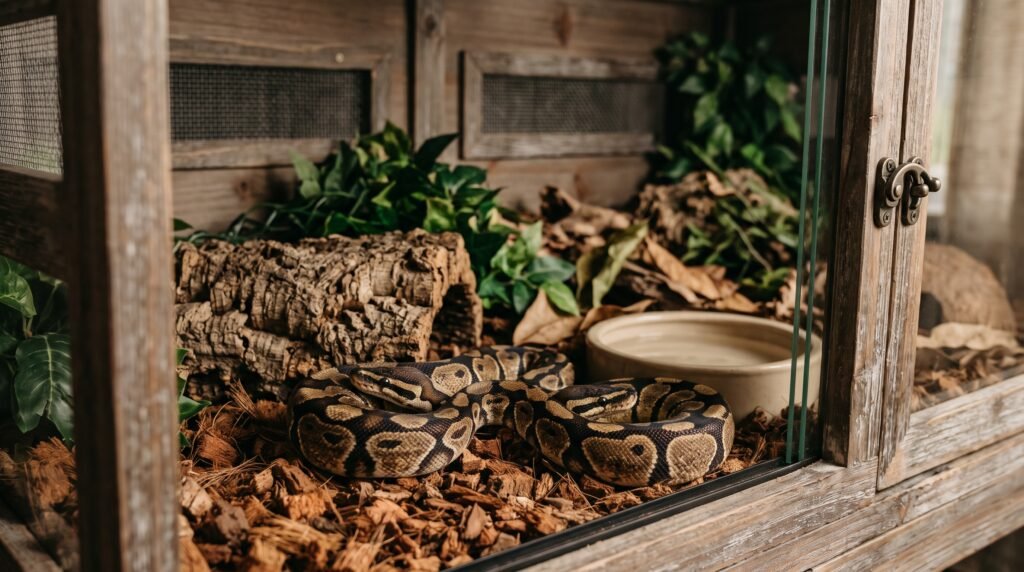
Ball python care comes down to a secure enclosure with a proper heat gradient, steady humidity around 50–60%, frozen-thawed rodents sized to your snake, and calm, consistent handling. Get those four things right and this is one of the most forgiving snakes you can keep.
Ball pythons earned their beginner reputation because they stay a manageable size, tend to be docile, and don’t need complicated equipment. “Easy” still doesn’t mean “no effort,” though. These snakes can live 20 to 30 years, and most problems new owners run into trace back to a handful of setup mistakes rather than bad luck. This guide covers the whole picture, from choosing a healthy snake to feeding, shedding, handling, and spotting health problems early. By the end you’ll know what to buy, how to set it up, and what a normal week of care looks like.
Here are the beginner care targets for an adult ball python at a glance:
| Care area | Beginner target |
|---|---|
| Enclosure | At least 36 x 18 inches of floor space, up to 48 x 24 inches for larger adults, with a secure locking lid or doors |
| Warm side | Roughly 88–92°F at the warm hide |
| Cool side | About 78–80°F, with nights around 72–78°F |
| Humidity | 50–60% day to day, 60–70% during a shed |
| Diet | Frozen-thawed mice or rats, about 10–15% of the snake’s body weight |
| Lighting | UVB is not required, but a day and night cycle helps |
| Handling | Short, calm sessions, never right after a meal or during a shed |
| Lifespan | Often 20–30 years with good care |
Is a Ball Python the Right Pet for You?
Ball pythons stay relatively small for a python, with adults typically landing around 3 to 5 feet, and females running larger and heavier than males. They’re quiet, don’t need daily interaction, and eat only every week or two. That makes them a good fit for people who want a calm, low-maintenance animal.
The catch is the commitment. You’ll be heating, humidifying, and feeding a living animal for decades, and you’ll need a vet who sees reptiles. Because ball pythons can carry bacteria like Salmonella, they’re also not ideal for every household. The CDC advises washing your hands thoroughly with soap and water after handling reptiles or their cages, and recommends that children under five and people with weakened immune systems avoid contact with them.
Choosing a Healthy Ball Python
Start with a snake that’s already eating well. I always recommend asking the seller directly whether the snake feeds consistently on frozen-thawed prey, since a poor eater is the single most frustrating thing a first-time owner can inherit. A healthy ball python has clear eyes, smooth clean skin, a rounded body with no visible ribs or sharp spine, and a firm, muscular feel when held. It should flick its tongue, respond to its surroundings, and breathe silently, with no clicking, wheezing, or bubbles around the nose or mouth.
Reputable breeders are usually the safest source because they can tell you the snake’s feeding history, weight, and hatch date. Whatever you choose, quarantine any new snake away from other reptiles for a while and plan a vet exam soon after bringing it home.
What You Need Before Bringing One Home
Set everything up and get it stable before the snake arrives. Running the enclosure for a few days lets you fix temperature and humidity problems without a stressed animal inside. A complete beginner list of ball python supplies usually includes:
- An enclosure with a secure lid or locking doors
- A primary heat source with a thermostat
- At least two reliable thermometers and a hygrometer
- Two hides, one warm and one cool
- A water bowl heavy enough that it won’t tip
- Substrate suited to holding humidity
- Feeding tongs and a supply of frozen rodents
- A small digital scale for weekly weigh-ins
Enclosure Size and Setup
Choosing the Right Size
Hatchlings do well in roughly 10–20 gallon equivalents, juveniles in 20–40 gallons, and adults need at least a 40-gallon breeder equivalent, with many keepers preferring a 4 x 2 x 2 foot enclosure. If you want the specifics for each growth stage, this breakdown of enclosure size by age is a handy reference.
Bigger isn’t automatically better for a small baby. An oversized, open space can leave a young snake feeling exposed and stressed, which sometimes shows up as refusing meals. Plenty of clutter and hides solve most of that, and you can upgrade as your snake grows.
Security Comes First
Ball pythons are surprisingly strong and persistent escape artists. Whatever enclosure you choose needs a lid or doors that latch, with no gaps around cords or vents. PVC and glass enclosures both work. PVC holds heat and humidity more easily, while glass is cheaper but loses heat faster. Walking through setting up the enclosure in order makes it much easier to get the details right the first time.
Hides and Decor
Provide at least two snug hides, one over the warm side and one over the cool side, so your snake never has to choose between feeling safe and staying at a comfortable temperature. Add clutter such as fake plants, cork bark, and a few branches for cover. A snake with plenty of places to disappear is usually a calmer, better-eating snake.
Heating and Temperature
Ball pythons are ectotherms, which means they regulate their body temperature by moving between warm and cool areas. Your job is to build a gradient, not a single uniform temperature.
Aim for a warm hide around 88–92°F and a cool side near 78–80°F, with nighttime temperatures in the low to mid 70s. Keep the warm spot from creeping above the low 90s, because too much heat is as dangerous as too little. Cooler-than-ideal conditions can contribute to poor digestion and respiratory problems, while overheating can cause stress and burns.
Most beginners use an under-tank heat mat or a radiant heat panel, and either must be controlled by a thermostat. A thermostat with a probe is the single most important safety item in the setup, because it cuts power before a heat source can climb to dangerous levels. Reviewing the recommended temperature ranges for each zone helps you place your probes correctly, and a reptile thermostat is far cheaper than a vet bill for a burn.
Measure surface temperatures where your snake actually sits, not just the air in the middle of the enclosure. A temperature gun or a probe thermometer placed at snake level gives the most useful reading.
Humidity
Most ball pythons do well at about 50–60% humidity, rising to roughly 60–70% when they’re getting ready to shed. Humidity that stays too low can cause stuck shed, while humidity that stays high and wet can contribute to scale rot and respiratory trouble. Moderate and steady is the goal.
A digital hygrometer placed at mid-height on the cool side gives you a dependable reading. If numbers run low, try a thicker layer of substrate, a larger water bowl, a humid hide filled with damp sphagnum moss, or a partly covered lid. If you want a closer look at how to hit your target, the guide to humidity levels walks through both raising and maintaining it.
Lighting
Ball pythons do not need UVB to survive, and many keepers successfully maintain them without it. Some keepers still add low-output UVB as an optional enrichment. Either way, provide a consistent light cycle with a natural day and night, such as 12 hours of light and 12 hours of darkness, and keep the enclosure out of direct sunlight, which can overheat it quickly.
Substrate
Good substrate holds humidity without staying soggy, and it should be safe if accidentally swallowed in small amounts. Cypress mulch, coconut husk, and similar blends are popular because they hold moisture well. Many keepers avoid cedar and pine shavings, which can irritate a snake’s respiratory system. Paper towels work well for quarantine and are easy to replace. A fuller comparison of substrate options covers what to use and what to skip.
Aim for around two to four inches of substrate, deeper if you’re trying to hold humidity, and spot clean as soon as you see waste.
Water
Offer fresh, clean water at all times in a bowl heavy enough that your snake can’t tip it over. Pick one large enough for your snake to soak in if it wants to. Change the water every two to three days, or immediately if it gets soiled, and scrub the bowl regularly. A big water bowl also helps boost humidity, so don’t be surprised if your snake spends time soaking, especially before a shed.
Feeding Your Ball Python
What to Feed
Ball pythons are obligate carnivores and need whole prey. In captivity, that usually means mice for babies and rats as they grow. Frozen-thawed prey is the standard choice because it’s convenient and much less likely to injure your snake than live rodents. A look at what ball pythons eat covers variety and alternatives in more detail.
If you ever have to offer live prey, never leave it unattended. Rodents can bite and seriously injure a snake, so supervise the whole time and remove it if your snake isn’t interested within about 15 to 30 minutes.
Picking the Right Prey Size
A reliable rule of thumb is to choose prey that weighs roughly 10–15% of your snake’s body weight. A 400 g snake, for example, would get a 40–60 g rodent. Prey that’s much larger raises the risk of regurgitation. Weighing your snake weekly with a small digital scale makes sizing far more accurate, and the guide to prey size is useful if you want to dig further.
How Often to Feed
Younger snakes eat more often than adults. As a general pattern, babies are commonly offered a meal about every 5 to 7 days, juveniles every 7 to 10 days, and adults every 10 to 14 days or even less often. Treat those numbers as a starting point and adjust based on how your snake looks. A healthy ball python has a rounded body with a gentle peak along the spine. A sharply visible spine suggests it needs more food, while a spine you can’t find suggests it needs less. A deeper breakdown of the feeding schedule can help you fine-tune this.
Thawing and Serving
Thaw frozen prey in the refrigerator overnight, then warm it in a sealed bag in hot (not boiling) water for about 15 to 30 minutes before feeding. You want it close to body temperature, around 98–100°F. Offer it with tongs, and avoid handling your snake during or right after the meal.
When Your Snake Skips Meals
Fasting is normal for ball pythons. They can refuse food during breeding season, cooler months, or before a shed, and adult wild ball pythons eat only about ten times a year on average. Don’t panic over one skipped meal as long as your snake looks healthy and isn’t losing too much weight. A drop of more than about 10% of body weight, though, is worth a call to your vet. If your snake refuses food for an extended stretch, check temperatures, humidity, and hides before anything else.
Shedding
Ball pythons shed their skin regularly, and young, fast-growing snakes shed more often than adults. As a shed approaches, the eyes turn bluish and cloudy, the skin looks dull, and appetite often drops. Within a few days the eyes clear up and the snake sheds, ideally in one complete piece.
Keep humidity on the higher end during this time and leave your snake alone as much as possible. If a shed comes off in patches or leaves behind retained eye caps or tail tips, humidity is usually the culprit. Understanding shedding signs and stages makes it easier to know when to step in and when to leave things alone.
Handling Your Ball Python
Give a new snake time to settle in before you begin handling. Many keepers wait a week or so before the first feeding and a bit longer before regular handling, depending on how the snake behaves. Once you start, keep sessions short and calm.
Support the snake’s body with both hands, move slowly, and avoid grabbing from above, which can feel like a predator attack. Skip handling during a shed, for about 48 hours after a meal, and whenever your snake seems stressed. Signs of stress include hissing, tensing up, repeatedly trying to escape, or curling into a tight ball. A balled-up snake isn’t being cute. It’s protecting itself. This overview of handling is a good companion once your snake is settled.
Always wash your hands before and after handling, which protects both you and the snake.
Cleaning and Hygiene
Remove waste as soon as you spot it. Replace soiled substrate and scrub the water bowl regularly. Plan on a full enclosure clean every month or so, or sooner if it gets dirty or smelly. Use a reptile-safe disinfectant, rinse thoroughly, and let everything dry before putting your snake back.
Keep your snake’s supplies out of the kitchen. Don’t wash its dishes or enclosure in a sink where you prepare food, and don’t let it roam freely around the house.
Health and Vet Care
Schedule a check with an exotics or reptile vet soon after you bring your snake home, then book regular wellness exams. Ball pythons hide illness well, so catching problems early depends on you noticing subtle changes. Weigh your snake weekly and keep a simple log.
Watch for open-mouth breathing, wheezing, bubbles at the nose or mouth, swelling or pus in the mouth, mites, repeated stuck shed, sudden weight loss, or long periods of lethargy. Any of these deserve prompt attention, and the list of common health problems covers what each sign might mean. When in doubt, call your vet rather than waiting.
Common Beginner Mistakes to Avoid
- Skipping the thermostat and relying on the heat source alone
- Trusting a stick-on dial thermometer instead of a digital probe or temperature gun
- Using a huge enclosure for a baby with too few hides
- Overfeeding, which is easy to do and leads to obesity
- Handling too soon after a meal or during a shed
- Leaving lid gaps that invite escapes
- Making several changes at once when something seems off, instead of adjusting one thing and observing
Frequently Asked Questions
Can I keep two ball pythons together?
Most experienced keepers house ball pythons separately. They’re solitary animals, and sharing a space can lead to stress, competition at feeding time, and difficulty monitoring each snake’s appetite and health. One snake per enclosure is the safer standard.
How long should I wait to handle a new ball python?
There’s no exact rule, but many keepers give a new snake about a week or two to settle, and wait until it has eaten at least once or twice before regular handling. A calm snake that’s feeding well is generally ready for short, gentle sessions.
Do ball pythons need a heat lamp or UVB light?
They don’t strictly need either. An under-tank heater or radiant heat panel on a thermostat is enough for many setups, and UVB is optional. What matters most is a proper gradient, a consistent day and night cycle, and good humidity.
How big will my ball python get?
Most adults reach around 3 to 5 feet, with females usually larger and heavier than males. Growth is fastest in the first couple of years, and most reach adult size by about three years old.
Are ball pythons safe for children?
They’re typically docile, but young children should always be supervised, and the CDC advises that children under five avoid contact with reptiles because of Salmonella risk. Handwashing every time is non-negotiable in any household with a ball python.
Final Thoughts
Good ball python care really is about consistency. A secure enclosure, a warm side around 88–92°F, humidity near 50–60%, properly sized frozen-thawed prey, and patient handling will carry you through the vast majority of what beginners face. Build the setup before the snake arrives, weigh your snake weekly, and keep notes so small changes stand out early.
Your next step is simple. Put a probe thermometer and hygrometer in your enclosure today, check the readings at snake level, and adjust before anything else. What’s the biggest question you still have about your first ball python, or what was the hardest part of your own setup? Share it in the comments, and explore the related guides across the blog to keep building your confidence.