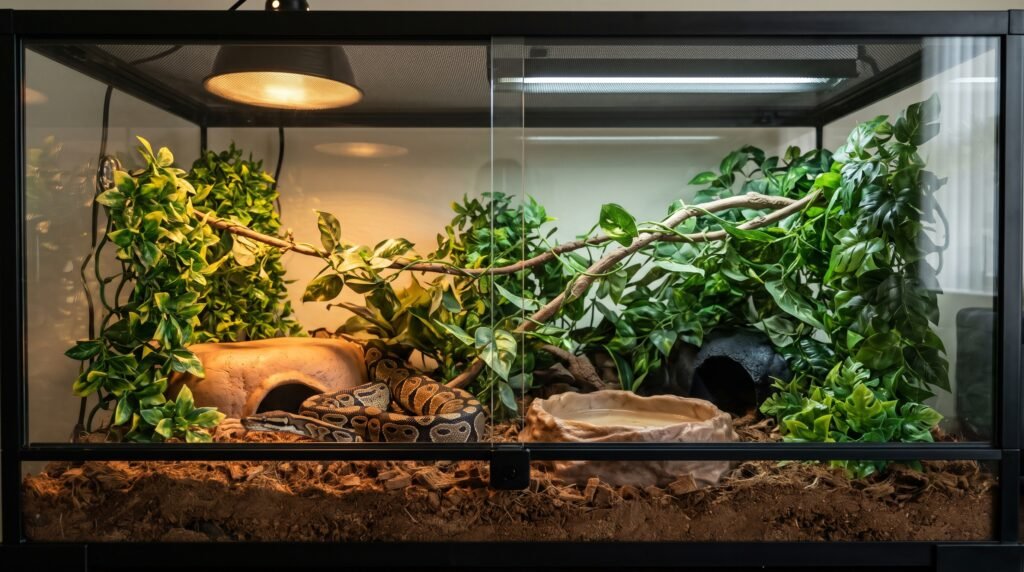
To set up a ball python enclosure, pick a secure, properly sized habitat, build a heat gradient controlled by a thermostat, then add substrate, two hides, a water bowl, and accurate gauges. Run everything for at least 24 hours before your snake moves in. Get those pieces right and daily care gets much simpler.
Most ball python problems, from skipped meals to poor sheds, trace back to the enclosure rather than the snake. These snakes are shy and cautious by nature, and they only settle in when the space feels secure and the temperatures are stable. This guide covers each step in order, so you can build a safe ball python habitat before your snake comes home, and it shows where mistakes are most common.
Here are the seven steps in the order I’d do them:
- Choose a secure enclosure of the right size.
- Install a heat source and control it with a thermostat.
- Add the right substrate at a workable depth.
- Place two hides, a water bowl, and clutter.
- Set up humidity and monitor it with reliable gauges.
- Pick a good room and a steady light cycle.
- Test everything for 24 to 48 hours.
1. Choose the Right Enclosure
The enclosure has to be escape-proof, hold heat and humidity well, and give your snake room to move between a warm side and a cool side. Ball pythons are strong and patient escape artists, so a lid that latches or locks is not optional.
Size depends on age. Hatchlings and young juveniles often do best in a smaller enclosure, since a huge open space can make a baby feel exposed and stressed. Care sheets commonly put adults in at least a 40-gallon breeder tank, while many keepers prefer a 4 x 2 x 2 foot enclosure so the snake has a proper gradient and room to stretch out. Our breakdown of tank size at each growth stage helps you decide when to upgrade.
Material matters too. Glass tanks are cheap and easy to find, but they lose heat quickly and humidity can be harder to hold. PVC and similar solid-sided enclosures keep both more stable. If you’re comparing enclosure options, I’d put heat retention and a secure locking mechanism ahead of looks.
2. Install and Control the Heat
Ball pythons can’t make their own body heat, so they need a gradient to warm up and cool down on demand. The usual target is a warm side around 88 to 92°F and a cool side in the mid to upper 70s, with nighttime temps staying comfortably above the low 70s. Avoid letting any surface the snake can touch climb above roughly 93 to 95°F. For the full zone-by-zone breakdown, see the ideal temperature ranges.
Under-tank heating is a popular choice for glass and many plastic enclosures. A heat mat works well when it covers only one side of the floor, which keeps the other side cool. Overhead options like radiant panels or ceramic emitters can work too, particularly in larger or cooler rooms.
Whatever you choose, plug it into a reptile thermostat. I consider this the most important safety piece in the whole setup. A heater running without a thermostat can overheat and burn your snake, and the thermostat probe should sit where it reads the actual heated surface, not the air.
3. Add the Substrate
Substrate is what you lay across the floor, and it affects humidity, cleanliness, and how easily your snake can burrow. For a ball python you want something that holds moisture without staying soggy, and that is safe if a little gets swallowed during feeding. Coconut husk blends, cypress mulch, and similar products are common picks, and a layer of about 2 to 3 inches lets the snake tunnel and keeps humidity steadier.
Skip anything with a strong scent or oils, such as cedar and pine shavings, since the fumes can irritate a snake’s respiratory system. Our guide to substrate choices covers what works and what to avoid in more detail.
Spread it evenly, then lightly dampen the lower layer only. The top should feel dry, because a constantly wet surface invites skin problems.
4. Place Hides, Water, and Clutter
A ball python that has nowhere to hide will often refuse food and spend its days stressed. Provide at least two snug hides, one on the warm side and one on the cool side, so your snake never has to choose between feeling safe and regulating its temperature. The hide should be tight enough that the snake’s body touches the walls when it curls up inside.
Add a water bowl large enough for the snake to soak, but sturdy enough that it won’t tip. Put it on the cool side, because a bowl over the heat source pushes humidity up and can leave you with a damp enclosure. Refresh the water daily and clean the bowl whenever it gets soiled.
Then add clutter. Fake plants, cork bark, and branches break up open space and create visual cover. A bare enclosure with two hides is workable, but a snake with plenty of cover tends to look and act more relaxed. If you’re unsure what to buy, this list of ball python supplies covers the essentials, and a starter kit can bundle several of them together.
5. Set Up Humidity and Monitoring
Humidity for ball pythons generally sits around 50 to 60 percent day to day, then rises to about 65 to 70 percent while the snake is in shed. PetMD notes that humidity should be bumped up to around 70 percent during shedding cycles and recommends measuring it daily with a hygrometer. Our guide to humidity levels explains how to raise it when it runs low.
Don’t guess. Install a digital probe thermometer and hygrometer, with one set on each side of the enclosure. Cheap dial gauges are notoriously inaccurate, and a handful of hygrometers and thermometers tested side by side shows how much readings can vary. Pair them with a temperature gun to double-check the actual surface temperature of the warm hide.
If humidity runs low, dampen the substrate in one corner, use a larger water bowl, or make a humid hide with damp sphagnum moss. If it runs high, increase ventilation rather than letting the enclosure stay swampy.
6. Choose a Good Spot and Light Cycle
Place the enclosure in a calm room, away from direct sunlight, drafts, vents, and constant foot traffic. Direct sun can cook a glass enclosure within minutes, and a loud, busy spot can keep a nervous snake on edge. Make sure the surface can support the weight of the full setup too.
Ball pythons don’t rely on special lighting to thrive, so a room with a normal day and night pattern, with lights off at night, is enough for many keepers. A regular cycle of roughly 10 to 12 hours of light helps keep their routine predictable.
7. Test Everything Before Move-In
Run the full setup for 24 to 48 hours before the snake arrives. Check that the warm side holds its target, the cool side stays in range, and humidity settles where you want it. Open and close the lid several times to confirm it locks firmly, and look for any gaps around cables or vents where a snake could squeeze through.
I recommend adjusting now rather than after the snake is inside. Moving a heat mat, adding a hide, or fixing a stubborn humidity swing is easy on an empty enclosure and stressful on an occupied one. Once readings hold steady across a full day and night, you’re ready.
Frequently Asked Questions
Can I use a heat lamp instead of a heat mat?
Yes, a heat lamp or ceramic emitter can work, especially in taller or larger enclosures where a mat can’t warm the air enough. Either way, run it through a thermostat and keep it positioned so the snake can’t touch the bulb or fixture.
How deep should the substrate be?
About 2 to 3 inches suits most ball pythons. That’s deep enough to hold humidity and allow a little burrowing without making the enclosure messy to maintain.
Should I handle my snake right after setting up the enclosure?
It’s better to leave a new snake alone for the first week or so. Let it settle in, learn the layout, and start feeding before you begin handling.
Final Thoughts
A good ball python setup comes down to a secure, right-sized enclosure, a thermostat-controlled heat gradient, two hides, a soaking-size water bowl, and gauges you can trust. Test it all before move-in and your snake starts out in a stable, low-stress home. Your next step is simple: set the enclosure up now and let it run for a full day, noting any readings that drift.
Which part of the setup has been trickiest for you, the heating or the humidity? Tell me in the comments. When you’re ready for the bigger picture, the complete ball python care guide covers feeding, handling, and health once your snake is home.